What to Expect When You Coat a Log Home
Logs soak, move and weather differently from siding, and a coating job has to account for that from day one.
October 27, 2026 · 4 min read
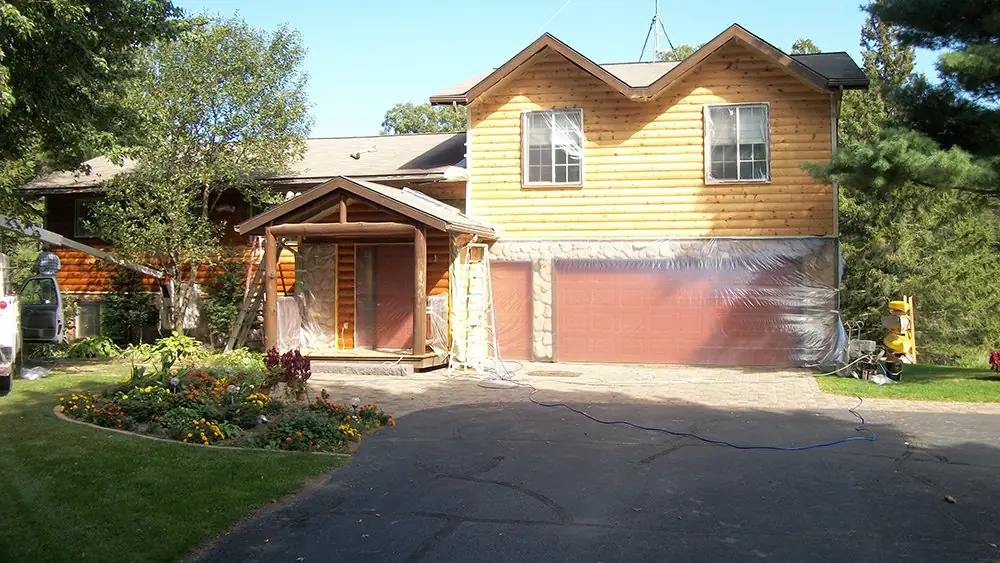
A log home asks more of a finish than a framed house with siding does. The walls are solid wood with a lot of surface area, deep grooves and joints where the logs meet. The wood takes on moisture, dries out, swells and shrinks with the seasons, and it gets full sun on some faces and wind-driven rain on others. A coating that suits a flat clapboard wall can fail fast on a log wall. Our crew coats log homes alongside our exterior house painting, and here's how we think about the process, so nothing about it comes as a surprise.
Start by reading the walls
Before anyone picks a product, the walls need a close look. We check what the current finish is doing. Is it a film that's peeling and lifting? A stain that has worn through to gray wood? Dark mildew streaks below the eaves? Sun-facing walls tend to wear faster than sheltered ones, so one house often shows four different conditions on four sides.
We also look for the things that matter more than color. Soft or punky spots can mean rot. Open checks (the lengthwise cracks that form in a log) can hold water. Gaps at joints, corners and around windows and doors let moisture in. Wood under decks and roof edges stays wet longer. A finish can't fix these on its own, so we flag them early and you decide with us what to do before any coating goes on.
Prep is the longest part of the job
On log walls, preparation does the real work, same as everywhere else we paint. The old finish and any gray, weathered fibers have to come off, or the new coating will bond to material that is already letting go. The tool depends on the wood and on what's on it. Pressure washing lifts dirt, mildew and loose finish. Hand tools reach into grooves, corners and the tight spots around windows. Where a finish is hard or heavily built up, blasting can strip it, though soft wood is easy to damage, so the method is chosen with care.
Typical prep on a log wall can include:
- Washing the walls to remove dirt, mildew and loose finish, then letting the wood dry before anything goes on.
- Taking off failed or peeling coating, along with the gray surface layer of weathered wood.
- Hand-cleaning grooves, corners and the areas around windows, doors and trim.
- Noting soft spots, open checks and failed joint sealant so they can be dealt with before coating.
- Masking or covering what shouldn't get coated, such as windows, roofing, decking, walkways and plantings.
Wood has to be dry enough to accept a coating. Rushing this step is how finishes trap moisture and blister later.
Choosing the finish
Log finishes fall into two broad families. Penetrating stains soak into the wood and leave a more natural look, and as they wear they tend to fade instead of peel. Film-forming coatings sit on the surface and give a more even color and a protective skin, but if water gets in behind them they can lift. Neither is right for every house. The choice depends on the look you want, the condition of the wood, how much sun and weather each wall gets, and how you plan to maintain it.
Our experts help you choose the right paint for each surface, and we work with Sherwin-Williams, Valspar, DuPont, Pittsburgh and Hallman Lindsay. Put color samples on the logs themselves, because the tone of the wood changes how any color reads.
Protecting the rest of the house
A log home job is messy, and everything around it should stay clean. Expect plastic sheeting and masking on garages, windows, doors, decks and anything near the walls, as in the photo at the top of this page. Sheeting looks dramatic, but it keeps overspray and debris off everything that isn't being coated. Plan to move vehicles, furniture and potted plants away from the walls beforehand.
What working with us looks like
- A walk-around before the work starts, with a talk about how you want the house to look and what we see in the wood.
- A clear plan for the prep, the finish and the order the walls get done.
- Updates as the job moves along, especially if something turns up once the old finish is off.
- A final walk-around so you can look at every wall and tell us if anything needs another pass.
Constant communication is how we describe it on our site, and on a log home it matters because you'll often find things behind the old finish that nobody could see from the ground.
Keeping the finish working
Once the logs are coated, a little attention goes a long way. Walk the house once a year and look at the sunniest and wettest walls first. Wash off dirt and mildew before it builds up. Touch up thin spots or small failures early, because a worn spot that gets recoated in time is a small job, and one left alone turns into a stripping job. Keep shrubs and firewood stacks back from the walls so air can move and the wood can dry.
Thinking about coating a log home? Call Harry Joles Maintain Painting & Sandblasting at (715) 643-5511 and we'll talk through what your walls need.
Harry Joles Maintain Painting & Sandblasting, (715) 643-5511
Call (715) 643-5511More articles
Why Surface Prep Decides How Long Your Paint Lasts
The best coating in the can still fails if it lands on a dirty, loose or rusting surface.
Painting Steel Farm Buildings, Roofs, Silos and Tanks
Steel doesn't forgive a rushed paint job, and the roof, the seams and the fasteners are where it shows first.